
Fair question.
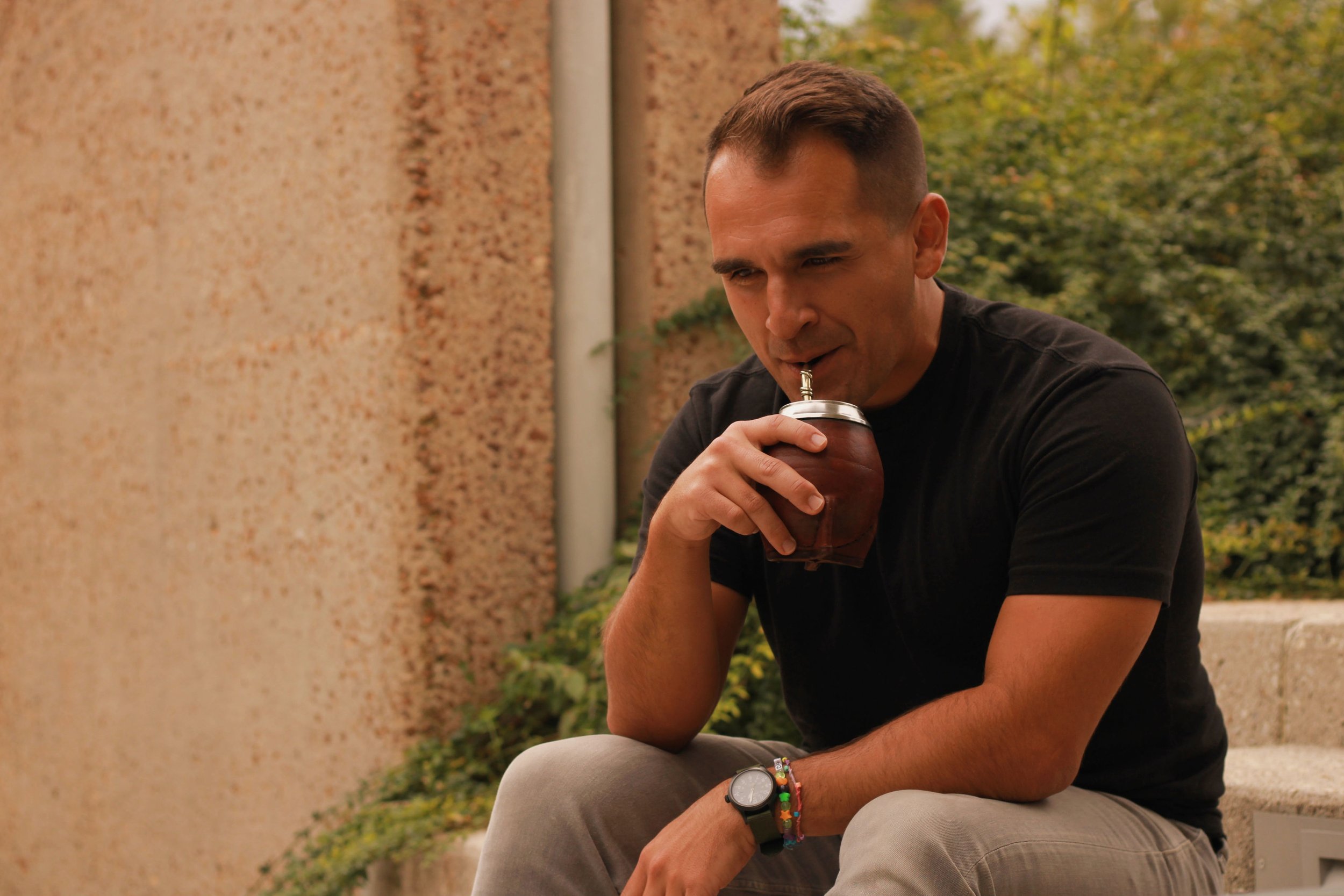
Photo by Ella Dixon.
I’m Brian Canever, an Argentine-New Jerseyan storyteller, content strategist and writing professor based in Knoxville, Tennessee.
I was born in Bayonne, New Jersey, to working-class immigrant parents. Which means that, despite my childhood dreams of pro sports, the Paris literary scene, or playing in a world-famous metalcore band, I still had to put away the books, log off Limewire, and spend Saturdays running copper pipe with my dad at plumbing jobs up and down the Garden State.
When I wasn’t screwing up as a plumber-in-training, I was scribbling words on napkins and notepads. Then came the internet: a shiny, new platform for my ramblings. The decades of weekend labor and blogging experiments taught me a valuable lesson: a job (or website) may look nice on the surface, but that doesn’t guarantee it holds water (converts).
Since earning a master’s degree in communications from the University of Tennessee in 2015, I’ve managed websites, birthed newsletters, run social media accounts, written big-time features for print and digital magazines, and just about anything you can do to earn money for your words. Today, I serve as associate director of marketing for the Global Supply Chain Institute at UT, where I’m also an adjunct professor of journalism.
Outside of work, I’m a husband, father, church musician, and serial hobbyist who will wax poetic about the joy of South American soccer, fly fishing, the humanities, tobacco pipes, and the underground emo scene of the 2000s.
In the Media
Interview: Big Ideas Welcome
TV segment: WATE Living East Tennessee
First off, what’s with the nickname? Isn’t that offensive?
For as long as I can remember, my grandfather has called me Cabezón, which literally means "Big Head." In my very Argentine family, Christian names count for little compared to your most prominent physical feature. My brother, who is short, is Piojo (louse). My dad, who is shorter, is Enano (dwarf). My grandmother is Gorda. It only gets worse from there.
In the Old Country, this is called affection. For years, I hated it—always less so, however, than my friends’ English version, Jenga. But eventually, I accepted that what at first may bring us shame is also what makes us memorable. I’m a showman, so I own it.
Interesting…So, I need a website. Why would I hire a writer and not a web designer?
Because a website is more than a website: it’s your case for why someone should understand, trust, and choose you. A designer can make a site look beautiful. A developer can make it function. But before fonts, colors, and Menu items, someone has to figure out what the site should say.
Think of it like this. It’s not enough to look good on a first date. You want the person sitting across the table from you to call their best friend as soon as they leave the restaurant to tell them exactly why you’re the one. (And it won’t be your muscles or hairline because middle age will ravage both.)
That is where a writer comes in. I clarify your message, organize your content, shape your story, and write the words that will help people decide whether you’re worth their time and money.
Okay, and you do other stuff, too? Like what exactly?
Basically, I help people explain important work clearly and compellingly.
I write the words that businesses and experts use when they need to be taken seriously by their audience. That can include website copy, founder stories, executive bios, LinkedIn posts, email campaigns, recruitment letters, brochures, speeches, podcast and video scripts, blog posts, op-eds, white papers, and media pitches. If it involves words, Big Head does it. (And, according to my list of happy customers, I do it well.)
You can break my work into five categories:
Websites: homepage copy, service pages, About pages, bios, site structure, and content audits
Storytelling: founder stories, product, program, and customer features
Thought leadership: blog posts, op-eds, white papers, newsletters, and expert articles
PR and visibility: media research, trade publication pitching, and content built to help people find you
Marketing and outreach: LinkedIn posts, email campaigns, brochures, recruitment letters, speeches, and scripts
Different formats. Same basic job: take the raw material—your ideas, notes, research, and highly specific rants about what makes you different—and turn it into content people can learn from and use to make decisions.
Oh yeah, and I do SEO, AEO, and GEO to make sure you get that content in front of the right people to begin with.
Why not just use ChatGPT?
Go ahead. ChatGPT, Claude, Co-Pilot, and other generative AI tools can help organize ideas, summarize background material, and pressure-test options. They’ll get you unstuck when the blank page mocks you.
But AI is a tool. It’s not a strategy or a substitute for good judgment or craftsmanship refined over decades. Just ask a fit mom why she buys her leggings at Lulu, or a fisherman why they drop hundreds on Costas when they could just buy cheap sunglasses at the gas station.
Many businesses, either for lack of time or cost, use AI to publish words that sound just like everyone else using AI: competent but lifeless—void of character and humanity.
A good writer does more than produce sentences. A good writer asks questions. What are you really saying about yourself? Who needs to hear it? What might they already believe about you? What have they misunderstood? How will you prove your point? Why should I trust you?
AI can help move the furniture around. But don’t hand a robot the keys to your brain or your business unless you want to end up in Ex Machina.
How about an agency? They’re credible.
Yes, definitely. And expensive! If you need a full campaign with design, development, paid media, analytics, brand workshops, account management, and a small army joining Zoom calls from tasteful offices, hire an agency.
But sometimes what you really need is one experienced dude who listens closely, understands the objective, organizes the message with an eye for detail, and executes the work without the complications (or waste) of a big machine.
When you go with Big Head, you get direct access to the person doing the work. There are fewer handoffs and a lower likelihood that your voice will be sanded down into something that says nothing.
My intern thinks they can do it for $15/hour.
Well, that’s good news! Your intern sounds smart, talented, and eager. Were they my student?
Look buddy, I’ve got four kids. So I know what it means to be frugal. But good writing goes beyond crossing t’s and dotting i’s. Why do you think good mechanics are in high demand? Skilled work takes time. Your website, op-ed, or newsletter may be the first serious impression people get of your work. How much is that worth to you?
Take a look at some of my featured projects for proof of what I can deliver.
Speaking of money, how much do you cost?
My standard freelance rate is $100/hour.
Projects that don’t make sense on an hourly basis can be scoped as a flat fee once I understand what you need, what you’ve got to work with, how much research or interviewing is involved, and how many rounds of revision we'll need before crossing the finish line.
I am not Amazon or Dollar Tree. When you hire me, you’re investing in expertise and skills refined over a long period and trusted by the big-shots. Award-winning feature stories? Check. Website and digital marketing cred? Yup. SEO? That, plus the AI search stuff, too! Social media, podcasts, pitches that have landed experts in the New York Times and Wall Street Journal? I got you, fam.
If you want cookie-cutter content fast and cheap, I’m not your guy. If you want thoroughness, thoughtfulness, and a top-notch product, we’ll have a blast together.
Alright, I’m in. So what will working with you look like?
Usually, we start with a 30-minute phone, Zoom, or coffee-table conversation.
I want to know what you are trying to say, who you need to reach, what materials you already have, and where you’re missing the mark. Sometimes that means looking at your website, reading old copy, or looking at examples of what you aspire for your work to sound like.
From there, I’ll recommend next steps: a website audit, project scope, interviews, messaging framework, social media campaign, blog post, media pitch, or something else entirely.
Once we agree on the scope, I do the work within a predetermined timeline and deliver a first draft to you, followed by up to two rounds of revision. The goal is not to make content that gets scrolled past or falls into the internet abyss. The goal is for your work to be clearer, weightier, and more memorable for your customers or audience.